Mitsubishi, Tencent and WWF unite to kick-start carbon credit buying in Asia
The launch of the coalition underscores the rapid spread of climate initiatives in the region. Read More

- The Action for a Resilient Climate Coalition brings together carbon credits buyers, service providers and other organizations.
- Members aim to drive procurements of at least 10 million credits by 2030 and ease due diligence for buyers.
- Some national trading schemes in the region allow credits to be used to meet emissions limits.
Asked to name a company with an ambitious climate program, even sustainability veterans would likely choose one from North America or Europe. But over the past year or so, a series of private- and public-sector initiatives have moved the center of gravity of corporate sustainability towards Asia.
The most recent nudge is the launch late last month of the Action for a Resilient Climate (ARC) Coalition, which aims to aggregate demand for at least 10 million tons of carbon credits by 2030. The organization brings together potential buyers, including Mitsubishi and Tencent, as well as carbon market service providers and the World Wide Fund for Nature Singapore.
The move comes just over a month after Japan’s own emissions trading scheme, known as the GX-ETS, became mandatory for hundreds of companies. China, South Korea, Indonesia and several other Asian countries are also operating trading schemes and related carbon pricing mechanisms. The spread is driven in part by the EU’s Carbon Border Adjustment Mechanism, which is motivating exporting countries to restrict domestic carbon in order to limit the bloc’s carbon-based import fees.
Asian countries are also starting to attract notice with splashy climate initiatives. GenZero, a $5 billion climate solutions investment platform owned by Temasek, Singapore’s sovereign wealth fund, has partnered with other notable funds, including Breakthrough Energy. Tencent is investing tens of millions of dollars in innovation competitions for carbon removal and other areas as it seeks to define itself as a sustainability leader. And a host of Asian businesses are setting emissions commitments: More than 1,200 have had theirs validated by the Science Based Target initiative in the 12 months prior to April, making Asia the fastest-growing region for target validation.
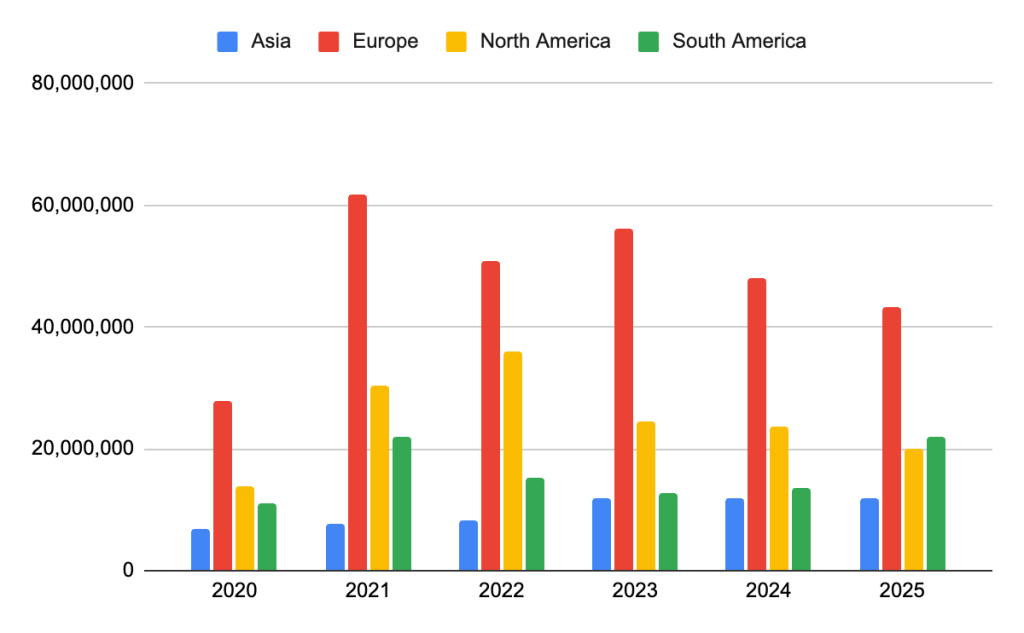
The ARC coalition builds on this momentum, and, added to the other developments, it could affect a change in the global use of voluntary carbon credits. Currently, Asia lags behind Europe, North America and South America in terms of annual retirements of credits, according to data from AlliedOffsets, a carbon markets data firm.
Carbon credit retirements
In addition to aggregating demand for credits, the coalition will create a financing facility for early-stage carbon projects, establish “transparent and robust standards” to guide buyers and curate specific projects to streamline due diligence. It’s also planning to partner with the Symbiosis Coalition, a buyers group focused on high-integrity, nature-based solutions backed by Google, McKinsey, Meta and others.
“If we can scale integrity alongside participation, carbon markets can become a far more effective channel for mobilizing private capital into a just transition,” said Frederick Teo, CEO of ARC member GenZero.

Subscribe to Trellis Briefing