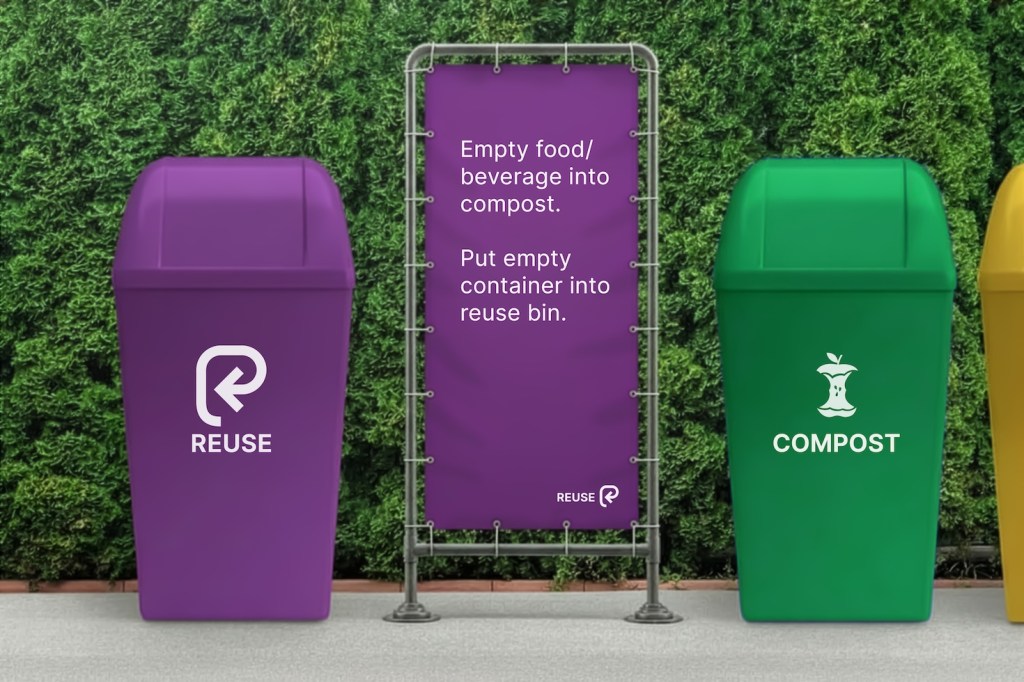
This new symbol indicates a bottle, cup or container is reusable
The new logo can be used by companies conforming to standards being developed by PR3: The Global Alliance to Advance Reuse. Read More
- Reusable packages are generally defined as ones that can be used 10 to 100 times.
- Companies including Burger King, KFC and Starbucks have been testing reusable cups and foodware for years.
- The systems needed for sorting, cleaning and collection, however, have proved difficult to scale.
An international coalition of businesses, governments, nonprofits, designers and packaging companies has introduced a universal identification symbol for reusable containers akin to the “chasing arrows” triangle used to flag materials that can be recycled.
The symbol — an arrow that loops back on itself — was one of 236 submissions in a year-long global design competition convened by PR3: The Global Alliance to Advance Reuse. It was designed by Epigrama Studios of Bogota, Colombia, and chosen after a jury review and market tests involving close to 1,300 consumers. The symbol is officially operational as of June 3.
“For reuse to succeed, people need clear, consistent cues that make participation feel intuitive and convenient,” said Marco Cimatti, former design director at PepsiCo and one of the jurors. “The new mark creates a unifying visual language for reuse systems. Designed with bold simplicity in mind, it balances uniqueness with a strong visual signal to reuse.”
PR3, launched in 2019, is responsible for standards related to reusable packaging and products. It is collaborating with certification company CSA Group on six frameworks that dictate how companies can use reusable packaging; so far, two have been released.
Difficult to scale
Reusable packages are generally defined as those that can be kept in circulation for 10 to 100 uses before needing to be recycled or re-manufactured for other applications.
Considered an environmentally preferred alternative to single-use options, they could, if widely adopted, reduce packaging-related greenhouse gas emissions by 80 percent. Fast-food chains including Burger King, Starbucks and KFC are piloting various approaches, including making it simpler for consumers to use refillable cups.
The systems needed for sorting, cleaning and collection, however, are difficult to scale. TerraCycle’s Loop initiative, for example, has been limited to France and retailers like Carrefour after tests in other markets, including the U.S., largely failed.
The new symbol introduced by PR3 can be used on packaging and reuse equipment once they’ve been certified under the alliance’s marking and labeling standards, which will be published soon by the American National Standards Institute. It will show up on reusable cups, foodware, bottles and other containers, as well as collection, washing, sorting and transportation equipment.
Some service providers are already using the symbols on containers and infrastructure on every continent except Antarctica, said Amy Larkin, co-founder and director of PR3. Examples include Muuse, which manages Starbucks’ reusable cup program in Hong Kong, and Re-Universe, which is collaborating in the U.K. with MasterCard on systems for managing reusable cup deposits.
Most current reuse systems are proprietary, limited to specific items or markets. That means the reusable cup or container dispensed by a restaurant, retailer or consumer products company probably needs to be returned to the same place, where it is cleaned and redistributed. The intent of the new visual marker is to help consumers figure out where items can be dropped off, regardless of system.
“The reuse symbol — and reuse at large — will be a true success when it proliferates and is recognizable to the average consumer,” Larkin said.

Subscribe to Trellis Briefing