Data centers are ground zero for AI backlash. Here’s what needs to change
Energy, water, land use, noise and e-waste are all sleeping giants — but communities are increasingly waking up. Read More
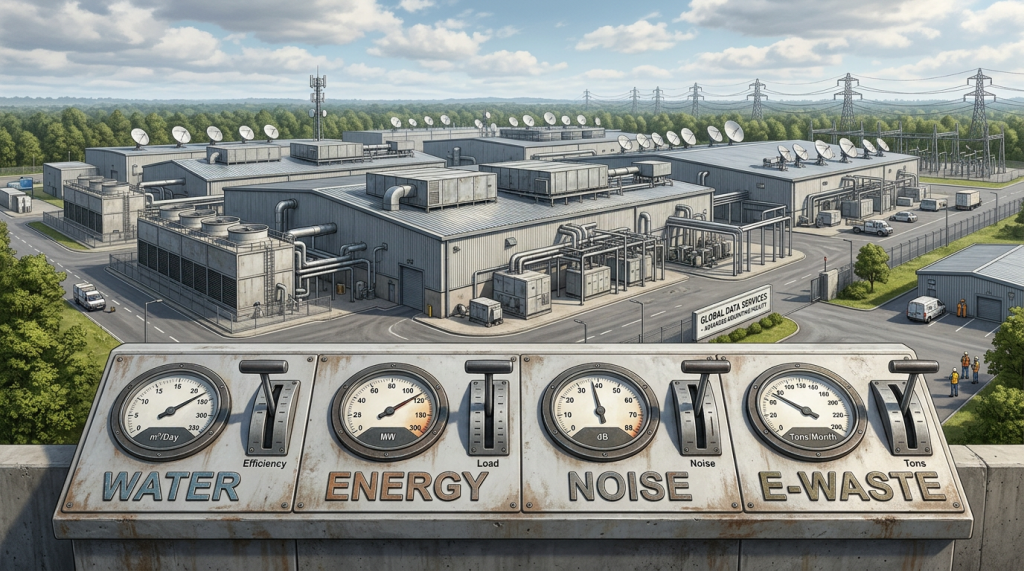
- Energy gets the headlines, but water, land, noise and e-waste are other dimensions of AI’s footprint — and far less visible in corporate reporting.
- Solutions exist across all five impact areas, but few have yet achieved the scale needed to matter.
- The missing ingredient isn’t technology; it’s disclosure standards, procurement requirements and design.
Here’s a data point worth considering: More Americans say they would rather live near a nuclear power plant than a data center.
You read that right. Data centers have become the bête noire of the age of artificial intelligence, according to a Gallup Poll released earlier this month.
There are several reasons, notably data centers’ prodigious energy and water needs, the impact of noise and land use on local communities, and their symbolism: For most people, data centers are the physical manifestation of AI — and of its discontents, from job loss to privacy concerns.
As a result, data center sustainability has become a social-license issue:
• Community opposition has blocked $18 billion and delayed $46 billion in U.S. data center projects since mid-2024 — that’s $64 billion in affected investment.
• At least 188 local opposition groups are now active across 40 U.S. states, advocating against the development of data centers. They are concerned about environmental impacts and local community effects. The opposition is rising amid increasing delays in projects.
• At least 12 states have filed moratorium bills on new data center construction permits so far this year.
• Data center project cancellations quadrupled to 25 in 2025, from six in 2024 — with 21 of those in the second half of the year alone, suggesting that the movement is accelerating.
It’s not just stateside. A court in Chile suspended a Google data center after locals discovered it would extract more than 7 billion liters (about 1.9 billion gallons) of water annually. Ireland, which deploys the highest share of national electricity into data centers of any country, now restricts new data centers around Dublin out of fear of causing blackouts.
The good news: solutions exist. The ultimate vision — water-, energy- and nature-positive data centers — may still be years off, but the tools needed to get there largely exist today.
We’ll be convening a group of professionals working on solutions to these challenges at an AI x Sustainability Infrastructure Forum, a half-day, invitation-only event as part of Trellis Impact 26 in San Francisco on June 24. The goal: to explore what it would take to make sustainable data center design the default rather than the exception.
Building the future
For most companies, AI use is part of Scope 3 greenhouse gas reporting obligations. The Task Force on Nature-Related Financial Disclosure appears to be moving toward making data center and AI-related nature impacts a disclosure consideration — though the sector guidance finalizing in June will be the real test.
That would mean companies might need to track and report some or all of these five dimensions of data center impacts:
Energy grabs the most headlines, and the numbers are startling. Global data center electricity demand soared 17 percent in 2025, well outpacing global demand growth of 3 percent, according to the IEA. Consumption is set to double by 2030; from AI-focused facilities, to triple.
Energy affordability is only one challenge faced by communities with data centers. Another: higher levels of dangerous air pollution, according to new research. Scientists say increased air pollution could lead to up to 1,300 premature deaths each year by 2030 at a cost of around $20 billion annually.
The industry has made a range of commitments — power purchase agreements, 24/7 carbon-free energy pledges, on-site renewables, growing interest in advanced nuclear and geothermal — though it’s unclear if pollution and decarbonization gains will keep pace with data centers’ surging energy demand.
Water is where the industry’s credibility is most at risk. An average mid-sized data center guzzles more than 300 million gallons of water per day for cooling. And the industry has a habit of siting facilities in some of the world’s most water-stressed regions.
The solutions, such as liquid cooling, closed-loop systems and dry cooling in appropriate climates, are mature and deployable today. What’s missing seems to be the will to deviate from tried-and-true approaches. “Water-positive” commitments have become a popular pledge among big tech companies, but the gap between what companies mean and what they measure isn’t always clear: Google, Microsoft and AWS have each committed to becoming water positive by 2030, meaning they will replenish more water than they consume, but not everyone is convinced.
Land and noise are where the backlash is getting organized. Data centers are getting increasingly bigger. Meta’s “Hyperion” AI data center, planned for Richland Parish, Louisiana, measures roughly 22.8 square miles, about the size of Manhattan.
And then there’s the noise. The dominant source is data centers’ cooling infrastructure — fans, chillers, cooling towers, HVAC units — not the servers themselves. So a lot of noise reduction effort is really cooling innovation in disguise, but tech alone won’t quiet this issue.
Almost a third of Virginia’s data centers sit within 200 feet of residentially zoned properties. That’s not a coincidence — it’s the predictable result of zoning codes that treat data centers like office buildings rather than the industrial facilities they are. These facilities run 24 hours a day. Cooling equipment generates a constant low-frequency hum that residents in multiple jurisdictions describe as inescapable.
Indeed, noise is increasingly being litigated as an environmental harm. Residents in Prince William County, Virginia, for example, have complained that data center noise levels — which they’ve dubbed the “Haymarket Hum” — routinely exceed 60 decibels, enough to make sleeping with windows open or sitting in a backyard genuinely unpleasant. The activist groups working to block or reshape data center projects are the direct consequence of an industry that consistently prioritizes speed over community relationship-building.
The solutions here are more procedural than technological: early, transparent community engagement before permits are filed, not after opposition has organized.
E-waste is another sleeping giant. AI hardware turns over fast — GPU generations are effectively obsolete every two to three years. A 2024 study in Nature Computational Science estimated that generative AI could add up to 5 million tons of e-waste by 2030, roughly an eighth of all projected global e-waste.
The circular economy infrastructure to handle that volume doesn’t exist. Take-back programs and design for longevity are nascent — and the AI hardware industry doesn’t have decades to build them.
Structural, not technical
As I said, solutions exist across all five dimensions. What’s missing is the regulatory, procurement and disclosure infrastructure to make them the default.
One key barrier: No one ever got fired for designing the next data center to be pretty much like the last one, so there are few natural incentives to try something different. And current reporting frameworks don’t cover water, land and waste with anything approaching the rigor applied to carbon, making comparisons difficult.
Still, enterprise AI buyers have significantly more leverage than they exercise — asking hyperscalers pointed questions about water consumption, hardware lifecycle and community impact as part of procurement could move markets. Most customers aren’t yet asking.
The most compelling work I’m seeing is from companies that treat environmental performance as a first-class engineering constraint from the start — not a retrofit or PR commitment made after permits are filed. That approach is increasingly also sound business design. The billions in stalled projects are making the ROI case more clearly than any sustainability framework could.
The AI x Sustainability Infrastructure Forum is an invitation-only event for registered attendees at Trellis Impact 26. To apply to participate, visit this link.

Subscribe to Trellis Briefing