How EY and Williams College created top-rated carbon credit portfolios
Many companies are pivoting to higher quality credit purchases — suggesting that confidence is returning to the market. Read More

The opinions expressed here by Trellis expert contributors are their own, not those of Trellis or its editors.
Let’s say your company is making progress toward reducing its overall environmental impact but wants to go further to compensate for the hardest-to-abate emissions. You know your peers are purchasing carbon credits to do so, but you’ve seen too many examples of a company buying the wrong kind and attracting negative media coverage — or spending way more money than you can afford.
Those concerns are not unfounded. But high quality is not always high cost. A recent Trellis article by Jim Giles highlighted three companies, Autodesk, EY and Salesforce, that topped the Calyx Global “large buyer” leaderboard for purchasing high-quality carbon credits. All have done so putting together portfolios of credits that are not only high quality but also control costs.
This article dives deeper into the credits purchased by two buyers on Calyx Global’s leaderboard—one large- and one small-volume buyer. It illustrates two journeys to high-quality carbon credit portfolios within two very different budgets, and why these companies’ paths make me optimistic about the future of carbon markets.
Large buyers diversify opportunities and risks
All three large buyers on the leaderboard — Autodesk, EY and Salesforce — purchased a diversified portfolio of credits. So what did they buy? Each combined nature-based credits with “super pollutant” credits.
I recently spoke with Valerie Lossman, environmental sustainability strategy and operations leader at EY (formerly Ernst & Young). She explained how EY addresses residual emissions within a broader, integrity-led net-zero strategy. EY purchased around 600,000 metric tons of higher-quality super-pollutant credits and over 300,000 nature-based credits. I asked how EY chooses their portfolio.
EY’s diversified portfolio approach balances different credit types to manage risk while delivering a broader set of outcomes, Lossman explained. The company expanded into super-pollutant credits, which provide high-confidence emissions reductions, alongside nature-based credits that generate important co-benefits for biodiversity and local communities. “We intentionally incorporate both technology-based and nature-based solutions to reflect the interconnected nature of climate and ecosystems aiming to deliver value beyond carbon mitigation alone,” Lossman said.
Small buyers test the waters and build budget-friendly portfolios
Smaller buyers are also moving to higher quality. In 2024, Williams College conducted a wholesale review of its approach in response to critical studies coming out about the quality of carbon credits. Officials wanted to know: “Did we make the right purchases?”
Following the review, Williams began with a small trial run of offset purchases to analyze and decide if their process was workable before committing the college to annual purchases, said Tanja Srebotnjak, Williams’ Executive Director of the Zilkha Center for the Environment. Ultimately, the college selected a portfolio of high-quality credits.
“Purchasing carbon credits and the not-insignificant budget that goes toward that is in some ways also a reminder that there is a cost to emissions, which helps us incentivize carbon reductions on campus,” said Srebotnjak.
The bulk of Williams’ purchases last year came from a super-pollutant project, which scored high for affordability. However, Williams also wanted to go further to support emerging technologies, so it purchased a small number of more expensive credits from a biochar project.
Srebotnjak said that over time she has become more confident in becoming a competent buyer in the market. “For smaller institutions or those just getting started, you don’t need to know everything on Day 1. It can be a process of learning and iteration.” Her budget for purchasing offsets has grown, as she has been able to increasingly make the case for maintaining carbon neutrality.
From market pessimism to optimism
A shift to higher standards has accelerated in the past few years. The chart below shows the integrity of credit retirements over time, aggregating the top seven buyers on the Calyx Global leaderboards. The improvement is notable.
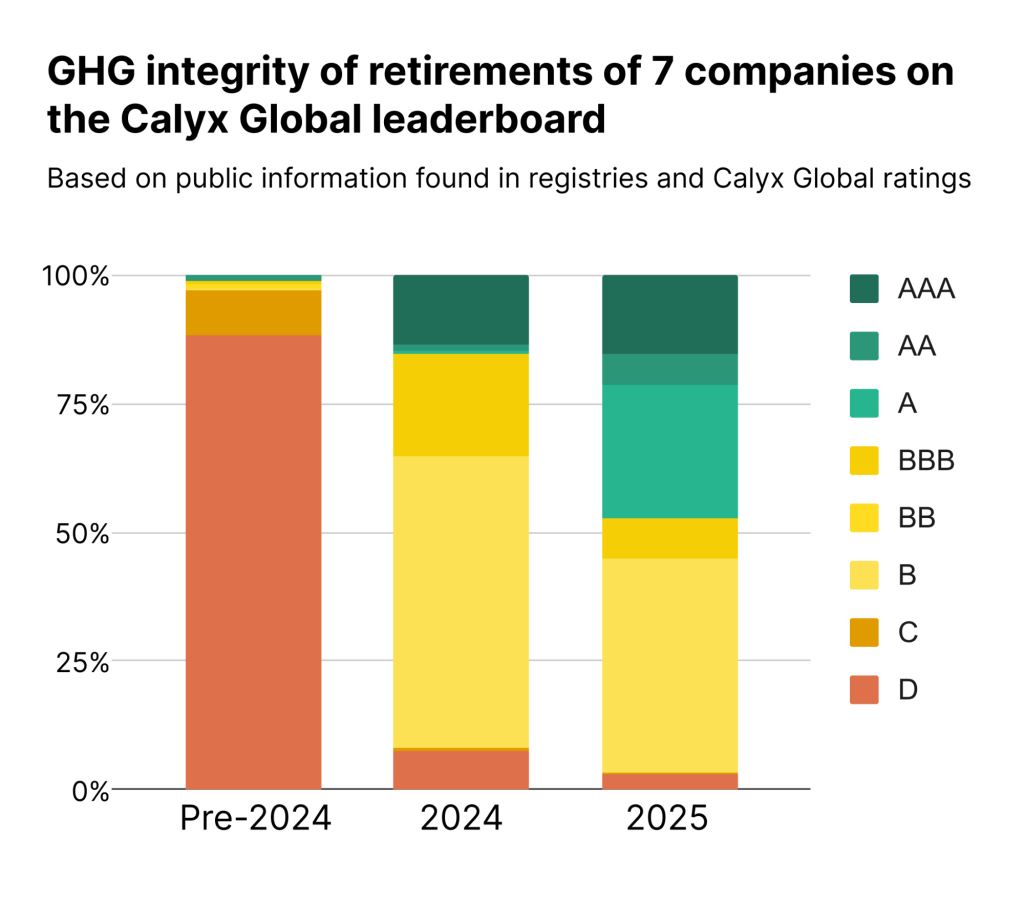
Source: Calyx Global. Based on public information and Calyx Global ratings
Many buyers lost confidence in 2023, when quality problems with VCM credits came to light. Today, many companies are pivoting to higher quality credit purchases — suggesting that confidence is returning to the market.
Some key lessons:
Start small. If you have not yet purchased carbon credits, follow Williams College’s example and buy a small amount, testing the process to see how it feels. Then iterate.
Diversify. One way to manage benefits and risks is to buy from multiple projects. EY selected projects for their high integrity, but also looked for “beyond carbon” benefits. Williams purchased super-pollutant credits, which are more cost effective, but balanced these with a small purchase of durable removals.
Improve continuously. EY said it continuously refines its criteria to reflect market developments. Similarly, Williams got started and layered onto its approach new tools to improve due diligence.
Build confidence in steps. Williams was able to start small and, over time, build confidence with internal stakeholders. This allowed the college to increase its budget and to maintain its carbon-neutral objectives.
Many companies follow the guidance of the Science-based Targets Initiative, which is set to adopt new guidance this year that may include recognition for near-term action that includes the use of carbon credits. If this helps get companies off the sidelines, and they follow the lead of organizations such as EY and Williams College, I believe the carbon market can turn a corner and become a more impactful tool to protect our planet.
Join Calyx Global, HKS and Workday for a panel session on “How to Secure Carbon Credits that Deliver Maximum Climate Benefits” at Trellis Impact 26 on June 23. Register by June 19 to save $200.

Subscribe to Trellis Briefing
Donna Lee
Featured Reports












The Premier Annual Event for Sustainable Business Leaders