Global AI sentiment gap emerges between Gen Z in U.S. and China
New global data reveals a sharp divide in Gen Z perceptions of AI risks across leading AI powers, with high concern in the US. and much lower concern in China. Read More

- Perceptions around the risks of AI vary widely across global markets.
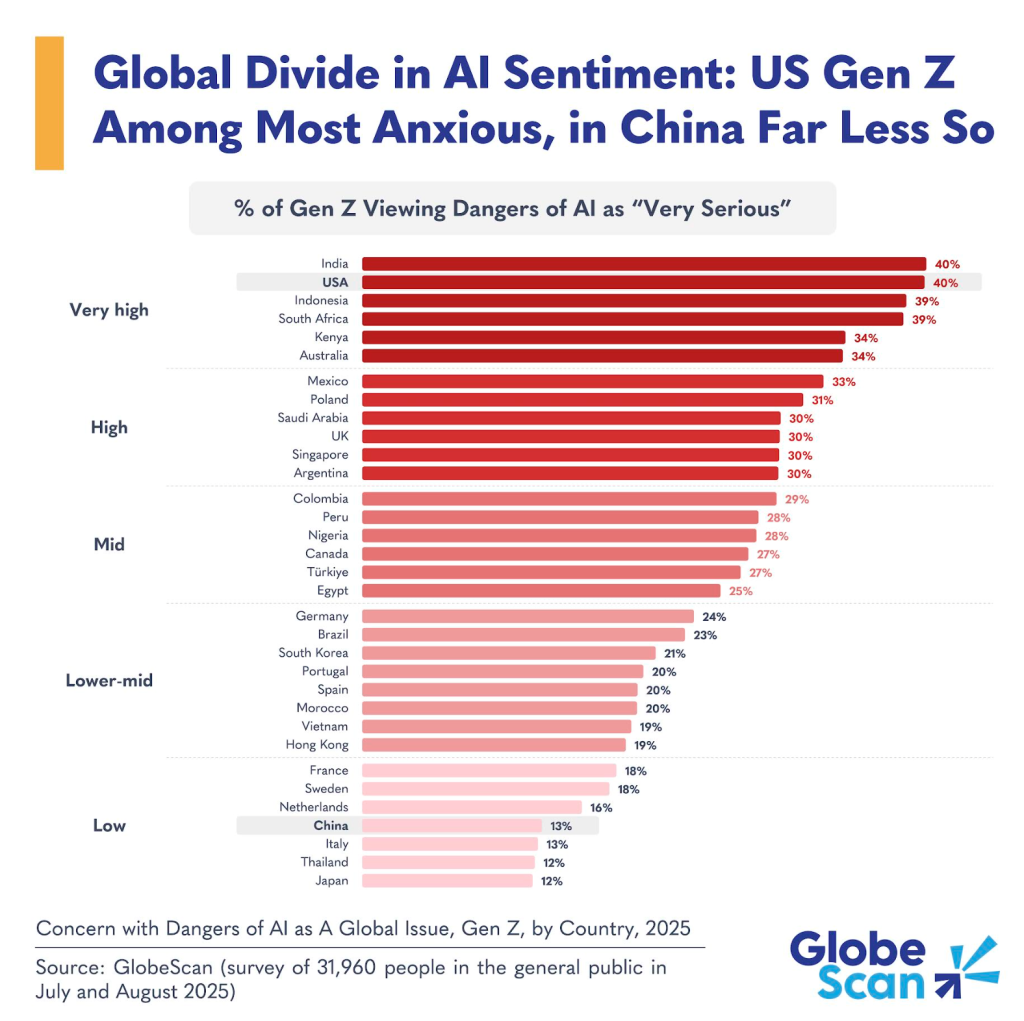
- The U.S. stands out for high concern, with 40 percent of its Gen Zers saying the dangers of AI are “very serious.”
- China sits at the low end, with only about 13 percent of Gen Z sharing this view.
Artificial intelligence is increasingly shaping how younger generations think about their future as they enter the workforce amid rapid technological change. While AI is often framed as a driver of innovation and growth, public debate has shifted in some markets toward more immediate concerns about jobs, economic opportunity and who stands to benefit. For Gen Z, these questions feel especially personal. This anxiety is becoming more visible through public reactions, including recent instances in which U.S. students have pushed back against pro-AI messaging at university events, such as the widely reported booing of former Google CEO Eric Schmidt at the University of Arizona’s graduation ceremony.
Against the backdrop of a more competitive labor market and an intensifying global race for AI leadership, GlobeScan’s latest public opinion data shows that concern about AI among Gen Z varies sharply across countries, with stark differences between the U.S. and China. Forty percent of American Gen Zers say the dangers of AI are “very serious,” placing it at the top of the global ranking with India (40 percent). Countries such as Indonesia (39 percent) and South Africa (39 percent) also show relatively high levels of concern. At the other end of the spectrum, China stands out for having just 13 percent of Gen Z viewing AI risks as “very serious,” alongside similarly low levels in Italy (13 percent), Thailand and Japan (both at 12 percent).
Europe sits broadly in the middle to lower range, with Germany (24 percent), Spain (20 percent), France (18 percent), Sweden (18 percent) and the Netherlands (16 percent) showing comparatively lower levels of strong concern. Overall, the results do not point to a single global view, but rather a spectrum wherein perceptions of AI risks among young people differ by nearly threefold between countries.
What does this mean?
The U.S.-China divide highlights a growing global gap, one that could shape not only public acceptance but also the pace and competitiveness of innovation.
For companies, this underscores the need to engage proactively with younger generations as they navigate the impact of AI on jobs, skills and opportunity. In higher-concern markets like the U.S. — as well as in India, Indonesia, South Africa and Kenya, where large Gen Z cohorts are entering the workforce — trust will depend on how responsibly AI is developed and used, and whether organizations demonstrate clear commitment to supporting their workforce and future employees through this transition.
Sustained concern among Gen Z could also translate into less willingness to take risks. If confidence in AI weakens, companies may face increasing scrutiny from employees, consumers and policymakers, potentially slowing adoption and creating backlash. At the same time, lower levels of concern in markets like China point to a more enabling environment for AI development, raising the possibility that differences in public sentiment could increasingly shape global competitive dynamics.
More broadly, this points to the core question about the social contract around AI: Do younger generations feel that technological progress is aligned with their economic interests and life prospects, or at odds with them?
Based on a survey of more than 31,000 people in the general public across 33 markets conducted in July and August 2025.

Subscribe to Trellis Briefing