Governance overtakes environment as top ESG reputational risk
New GlobeScan data reveals a significant shift in the ESG risk hierarchy among corporate affairs leaders. Read More

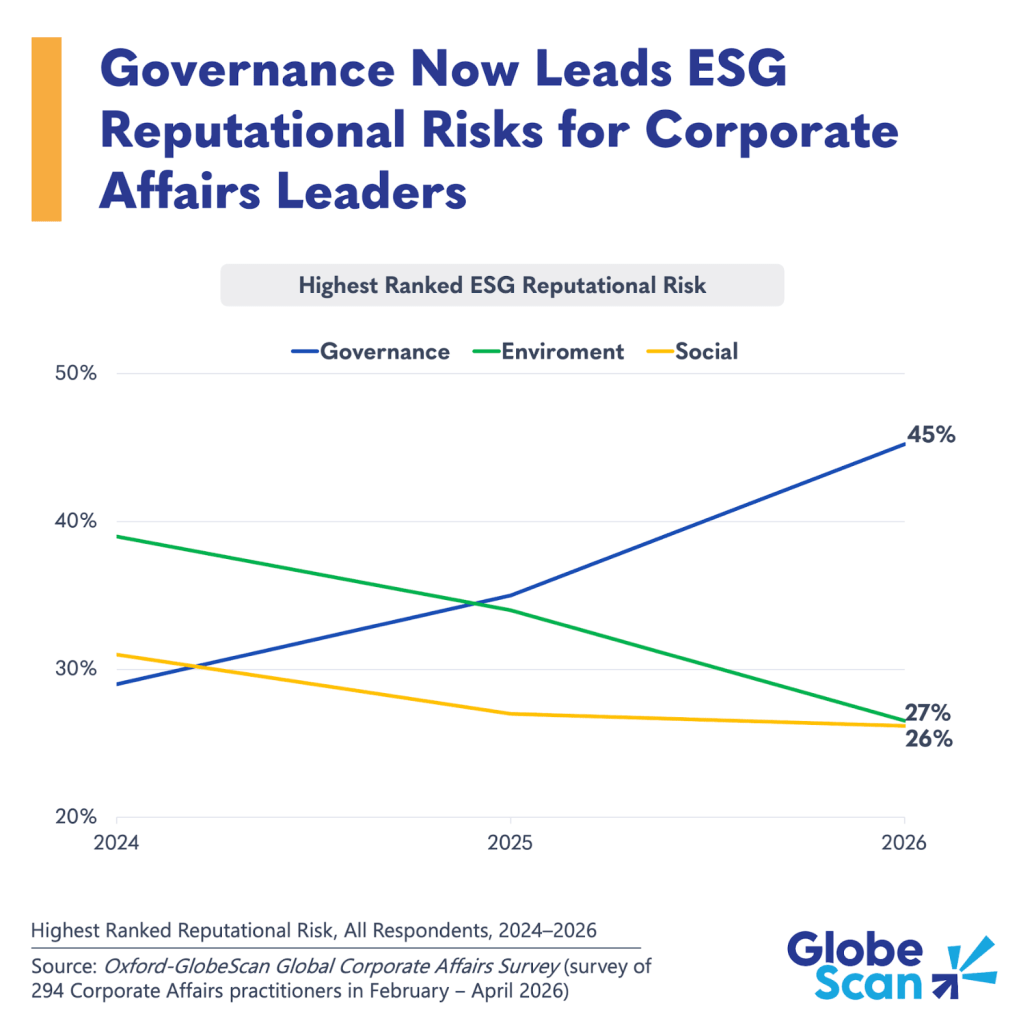
- Some 45% of corporate affairs teams rank governance as the top ESG reputational risk area.
- Concern about environmental risks has declined from 39 percent to 27 percent over the same period.
- This reordering, which highlights rising concern over corporate ethics and accountability, suggests an opportunity to reposition sustainability as a driver of governance excellence.
GlobeScan’s 2026 corporate affairs survey reveals a notable reordering of perceived ESG risks. For the first time, governance-related issues have overtaken environmental concerns as the No. 1 reputational risk for global businesses, based on how corporate affairs leaders rank the three pillars of ESG (environment, social and governance).
The data shows that in 2026, nearly half of respondents (45 percent) identify governance factors as the greatest reputational risk to their own companies. This marks a substantial increase from 2024, when a much smaller share (29 percent) ranked governance first. During the same period, the proportion of corporate affairs practitioners who considered environmental issues their top reputational threat fell from about four in 10 in 2024 (39 percent) to fewer than one in three in 2026 (27 percent). Meanwhile, social issues remain the lowest ranked of the three categories, hovering around 30 percent, indicating little change in perceived risk from this area year over year.
The sharp rise of governance as a reputational risk suggests that corporate affairs professionals are increasingly concerned about internal governance, ethics and compliance-related failures, potentially driven by growing stakeholder scrutiny, regulatory pressures and high-profile corporate lapses in recent years. Environment, which has long been the leading ESG concern, has seen a relative decline in urgency in the eyes of these leaders. This drop is striking given that climate change and environmental sustainability have dominated corporate risk agendas in the past. It may indicate that many companies feel that environmental issues, while still significant, are better understood or managed than before, or that other emerging risks have temporarily pushed environment down the priorities list. Social issues have consistently been rated as a lower perceived risk to reputation, which could imply that these issues (e.g., community impact, inequality or workforce diversity) are viewed as less likely to generate immediate reputational crises. Alternatively, they may be undervalued amid louder global challenges.
What does this mean?
With governance risks now front of mind, sustainability practitioners need to work more closely with corporate affairs and legal teams to embed transparency, ethics and accountability into sustainability strategies. This shift also suggests an opportunity to reposition sustainability as a driver of trust and governance excellence, rather than viewing it solely through an environmental lens.
Based on a survey of nearly 300 corporate affairs practitioners across global markets between February and April 2026.

Subscribe to Trellis Briefing