Starbucks’ climate dilemma: the world loves lattes
The world’s largest coffee chain’s methane emissions from dairy farms haven’t budged since 2019. Reducing that footprint is essential for the next phase of its complex decarbonization strategy. Read More

- Cultivation of Arabica coffee beans and dairy milk, Starbucks’ two most widely used ingredients, accounted for 25 percent of its footprint in 2024.
- Starbucks was due to begin a five-year review of its emissions reduction targets in April.
- Climate-conscious investors are eager for the company to publish a detailed climate transition plan.
Starbucks’ pledge to cut its greenhouse gas emissions, water consumption and waste in half by 2030 remains the boldest climate commitment among leading coffee chains.
The targets, announced in 2020, were part of then-CEO Kevin Johnson’s vision to create a “resource-positive” company, and Starbucks’ emissions reduction goal was validated by the Science Based Targets initiative (SBTi) in March 2021.
Since then, Starbucks, the world’s largest coffee retailer, with more than 40,000 locations in 88 countries, cut total emissions per dollar of revenue by an impressive 25 percent through fiscal 2024, the last period for which data is publicly available as of publication. The cuts were achieved largely due to Starbucks’ deep expertise in coffee sourcing and prescriptive operational requirements for its cafes.
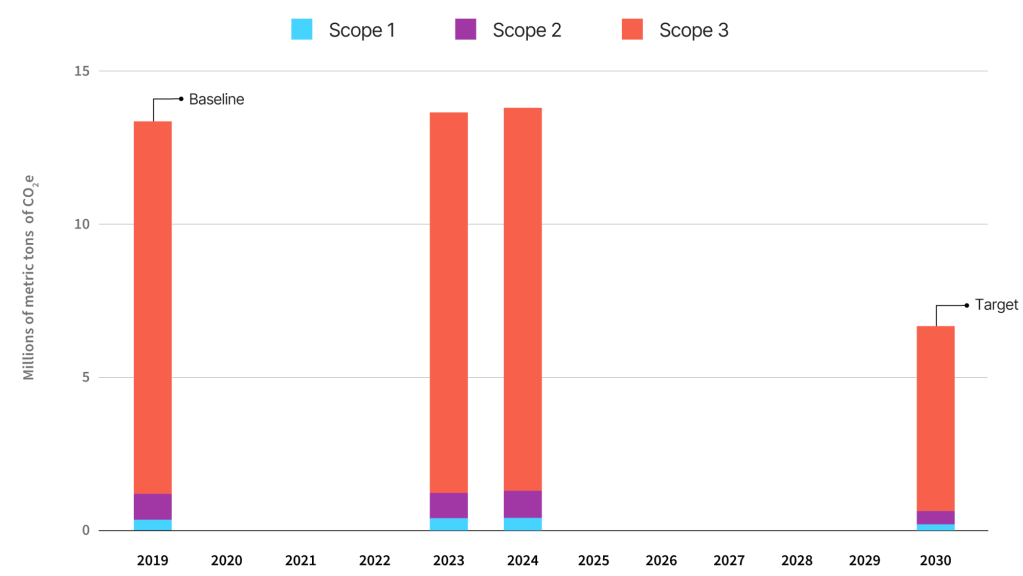
But Starbucks’ absolute carbon footprint grew 3 percent from 2019 to 2024, as the company added more than 7,000 locations globally. There’s no clear path to make up that ground by 2030, given the wide breadth of the coffee chain’s emissions exposure.
During that same timeframe, the company grew annual revenue by more than 37 percent to $36.2 billion. Former Chipotle CEO Brian Niccol was hired in September 2024 to improve Starbucks’ profits, refresh its menus and re-energize its growth potential but has said little publicly to address the company’s ongoing climate commitments.
“There is a mismatch between Starbucks’ ambition and its expected emissions,” said Hannah Rojas, an analyst with ESG research firm Morningstar Sustainalytics. The company’s current trajectory would cut emissions by an estimated 13 percent by 2030, the firm estimates.
This latest installment of Chasing Net Zero — the Trellis series assessing the climate strategies of high-profile companies including ArcelorMittal, General Motors and Salesforce — examines Starbucks’ options in the context of Niccol’s aggressive financial turnaround plan.
Beans and milk
Our analysis of Starbucks’ annual impact reports and other disclosures reveals that no single category accounts for more than 13 percent of its total carbon footprint.
Together, Arabica coffee beans and dairy milk — Starbucks’ two most widely used ingredients — accounted for 25 percent of the chain’s emissions in fiscal 2024. To dramatically reduce emissions, the company needs a bolder recipe to tackle its biggest product liability: lattes brimming with dairy milk.
There are at least a dozen latte recipes on typical Starbucks menus, each with a far weightier footprint than other beverages — unless they’re made with plant-based milk. Research from CDP estimates that a dairy milk latte generates 840 grams of carbon-dioxide equivalent (CO2e) emissions, more than three times the figure for a black coffee.
The big culprit is methane emitted by dairy cows and the crops used to feed them. The potent though short-lived greenhouse gas — which traps 80 times more heat than carbon dioxide — is Starbucks’ largest single source of emissions at 13 percent, and absolute methane emissions grew 6 percent between 2019 and 2024.
The solutions are neither simple nor self-evident. Can Starbucks encourage customers to drink enough plant-based milk to make a difference? Should the company reset its emissions reduction target, as other companies heavily dependent on agricultural commodities, such as PepsiCo, have done?
Market realities
Starbucks executives face these central questions as the company starts a five-year review this spring of its science-based targets, as required under SBTi governance.
Investors, consultants and academics interviewed over the past nine months were eager to see Starbucks publish a climate transition plan detailing how it will achieve its ambitious 50 percent cut. Reducing methane emissions from Starbucks’ supply chain will be an important ingredient to fuel progress, they said.
The company declined Trellis’ request to interview its Chief Sustainability Officer Marika McCauley Sine. Starbucks helped verify facts but said it was unable to provide additional information beyond what’s available in public disclosures. Starbucks historically publishes its annual impact report in April, but an update for fiscal year 2025 was not published in 2026 as of publication. The company would not indicate when it is expected.
Starbucks’ challenges are hardly unique. “Sustainability in the food and beverage space is struggling,” said Charlotte Bande, sector lead for consulting firm Quantis. Major food and beverage companies including Coca-Cola, Kraft, Nestlé (also the subject of a Chasing Net Zero profile) and Starbucks have experienced a wave of CEO turnover since 2024, and many sustainability teams now must readjust and rejustify their strategies.
“It becomes imperative to figure out the business case,” Bande said. “But coffee is at risk from climate change, and that is important.”
Starbucks emissions and target
The sector leader
Starbucks’ bold emissions reduction commitment, its demonstrable progress on emissions intensity and detailed annual disclosures about progress are unique among large coffee chains.
Rival Dunkin’ Donuts, for example, promised to cut energy consumption 20 percent by 2025 but hasn’t set an emissions reduction goal or offered an update since it was acquired by Inspire Brands in 2020. Restaurant Brands, owner of Tim Hortons, is targeting a 50 percent emissions reduction by 2030; it’s reducing methane emissions but doesn’t publish subsidiary data. And Costa Coffee, owned by Coca-Cola, has said it will halve emissions from each cup of coffee by 2030 but remains quiet on its progress.
The Transition Pathway Initiative, a nonprofit that rates corporate climate strategies on a 0-5 scale, awarded Starbucks a 4 — a recognition of moves such as the company’s disclosure of methane emissions and linkage of executive compensation plans to climate metrics, said Jon Ward, an analyst with the initiative. Most quick-serve restaurant companies, including Restaurant Brands, earned a score of 3.
One Starbucks success story is its Greener Stores initiative, 25 operational requirements introduced in 2018 for energy efficiency, waste diversion and water stewardship. The program cuts per-store energy usage an average of 30 percent and saves $60 million in annual costs.
But electricity is a sliver of Starbucks’ footprint. The vast majority, 95 percent, comes from sourcing ingredients and other indirect business activities. Those emissions reached 12.5 million tons of CO2e (tCO2e) in 2024, a rise of 2.6 percent since 2019.
Starbucks has made real progress on reducing emissions related to Arabica coffee bean cultivation, about 12 percent of that bucket. It buys 5 million bags annually, or 3 percent of global production.
Starbucks’ growers generated an estimated 1.6 million tCO2e in 2024 — a sizable number in absolute terms, but 300,000 tCO2e below the figure for 2019. That’s a notable achievement given that annual sales grew from $27 billion to $37 billion in that five-year period.
The reductions were largely enabled by Starbucks’ “Coffee and Farmer Equity Practices,” or “C.A.F.E.,” certification standards that require farmers to cut fertilizer and energy use, improve organic residue management and plant shade trees to increase carbon sequestration and soil health. Introduced in 2004 in collaboration with nonprofit Conservation International, the practices are required under its procurement policies and have been adopted by almost all of Starbucks’ 440,000-plus coffee suppliers.
A menu of options
Starbucks continues to raise the bar for the C.A.F.E. program, but it needs to accelerate reductions in other areas.
“They are staying the course, which we appreciate, especially considering that there are other factors to consider,” said Giovanna Eichner, a shareholder advocate with institutional investor Green Century Funds. But going forward, she added, the fund wants to see a clearer commitment to targets. “That is where we see the gap. There is no roadmap.”
What should be part of Starbucks’ updated recipe for emissions reductions? Here are ideas suggested by experts who spoke with Trellis.
Option 1: Invest more deeply in regenerative agriculture
Starbucks has distributed more than 100 million “climate-tolerant” trees and spent more than $150 million to help smallholder farmers invest in regenerative agriculture practices that further reduce dependence on fertilizer — one of Starbucks’ biggest remaining tools for further reductions. The company has also pledged to buy coffee only from suppliers that don’t remove native trees or convert forests for crops.
These initiatives deserve priority attention. “When these practices are paired with regular risk assessments and a focus on continuous improvement at the field level, coffee supply chains are much better positioned to reduce emissions,” said Miguel Gamboa, lead for sustainable agriculture and coffee with the Rainforest Alliance, an NGO focused on biodiversity protection.
What level of reductions might be achieved? A 2025 analysis by consulting firm Terrascope suggests that coffee companies can find cuts of almost 20 percent by implementing three practices within their supply chains, all of which Starbucks is encouraging: decreasing fertilizer usage (10 percent cut); converting waste biomass from coffee cultivation into biochar, for use as a soil amendment (7 percent); and recycling wastewater from milling coffee cherries (2 percent).
Combined with the absolute emissions the company has already cut from its coffee purchases since 2019, the analysis suggests a total cut of near 30 percent is possible.
Option 2: Prioritize methane emissions reductions
Starbucks declined to share additional details about its methane-reduction plans beyond what it published in May 2025 in its dairy action plan, or the potential impact those measures could have. But experts said there are multiple levers it can pull to reduce methane.
Where Starbucks’ methane emissions comes from
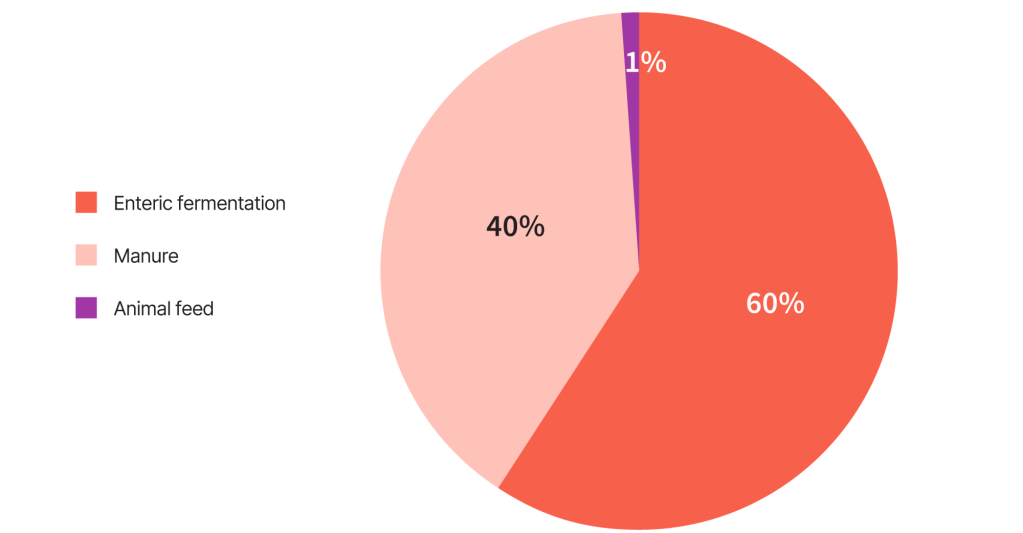
One option is to encourage adoption of advanced manure management practices that separate solids from liquids. Most manure-related methane emissions are released as the solids break down in wet, oxygen-deprived conditions. Drier manure releases less methane as it decomposes.
The technology is mature but technical knowledge is lacking and the upfront cost can be intimidating for farmers with slim profit margins, said Swati Hegde, manager for agricultural methane at World Resources Institute. “These are technologies that are just waiting to be implemented,” she said.
Introducing feed additives that reduce the methane that cows generate during digestion (a process called enteric fermentation) are another nascent option with huge potential. But these “are not change-the-lightbulbs types of solutions,” said Katie Anderson, senior director of business, food and forests for the Environmental Defense Fund. It will take time and ongoing support for research to ensure feed additives are safe for animals and that they have the intended impact, she said.
Rolling out these and other solutions will require close collaboration between Starbucks and individual farms, said Jessie Deelo, founder and CEO of The Climate Source, an agricultural climate strategy firm. Starbucks can encourage adoption of methane-reduction measures, for example, by rewarding farmers and enabling processors to trace outcomes through the value chain. Both Mars and Danone offer a price premium to milk producers that are using sustainable agricultural practices and that can demonstrate improvements.
Starbucks is pursuing several of these solutions. Since 2023, the company has published sustainability standards for dairy suppliers and committed close to $20 million to testing feed additives and upgrades to manure management systems. It’s also said it will begin adopting feed additives at scale during the fiscal year that started October 2025.
It’s difficult to assess the potential impact of these measures, but there are hints it could be meaningful. Cheese maker Bel Group is rolling out feed additives across its dairy suppliers in Slovakia and France, for example. The company’s earlier pilots demonstrated that the additives can cut enteric methane emissions by 29 percent to 42 percent. And Danone is using manure management and other practices to stay on track for a 30 percent cut in methane emissions from fresh milk by 2030.
Option 3: Promote plant-based dairy
Another option is to use less dairy. One of the first things that Niccol, the CEO, did after joining Starbucks was to ditch a consumer surcharge for milk alternatives made from oats, almonds, soy or coconuts. It wasn’t explicitly an environmental gesture.
Some smaller chains, including Blue Bottle Coffee and Stumptown Coffee Roasters, have made plant-based milk their default selection. Starbucks could reduce its own impact by adopting the same strategy.
“A clear, time-bound sales-mix goal — for example, increasing plant-based dairy sales to at least 60 percent of total dairy sales by 2030 — would show genuine commitment and have real impact,” said Urska Trunk, senior campaign manager at activist nonprofit Changing Markets Foundation, which tracks dairy methane action.
Option 4: Acknowledge learnings and reset
With multiple options for cutting coffee and dairy emissions being tested and deployed, Starbucks could conceivably bend the curve by cutting emissions from these sources by around 30 percent, based on research about the impact of these measures. That would be a huge achievement — but not enough to reach its goal of halving its total footprint by 2030.
And what if Starbucks thinks halving emissions by 2030 is no longer possible? Then it should change its goal, said experts. It would not be the only food company to do so: PepsiCo cited shifting geopolitical and economic conditions as a reason for downgrading its climate plans.
“I believe that changing your target and being honest and realistic about why represents real leadership,” said Alison Taylor, a business ethics specialist at New York University’s Stern School of Business (and a Trellis contributor). “I don’t think sticking to your guns and pretending everything will be all right is effective.”

Subscribe to Trellis Briefing