What’s your space strategy? Why organizations must determine what matters before markets do
In the new world, waiting and seeing is no longer a viable strategy. Read More

- In today’s rapidly shifting environment, validation has become a lagging indicator of strategic relevance.
- The challenge has evolved from identifying proven solutions and scaling them, to recognizing the strategic relevance of those solutions before definitive market validation arrives.
- Organizations that engage early gain more than information: They influence the conditions that ultimately determine how markets develop.
The opinions expressed here by Trellis expert contributors are their own, not those of Trellis or its editors.
“What’s our space strategy?” is a question most organizations can comfortably ignore. After all, space remains a niche concern for all but a handful of companies, and most executives have more immediate priorities than orbital infrastructure, satellite manufacturing or the commercialization of low-Earth orbit.
Yet the question reveals a broader shift already reshaping corporate decision-making.
Organizations are increasingly being forced to determine what’s going to matter before markets can determine what does matter. AI, carbon removal and quantum computing all became strategically relevant long before their commercial or technological pathways were demonstrated. The challenge was not predicting the future. It was recognizing relevance before the proof arrived.
Across our recent conversations with sustainability leaders, investors, founders and corporate executives, this dynamic appeared consistently. Regardless of industry or technology, many described feeling pressure to engage with emerging opportunities before traditional indicators provided confidence.
Space may simply be the next example.
The real question is not whether your organization needs a space strategy; it’s how leaders can determine what’s coming before they can show that it’s arrived.
Relevance before validation
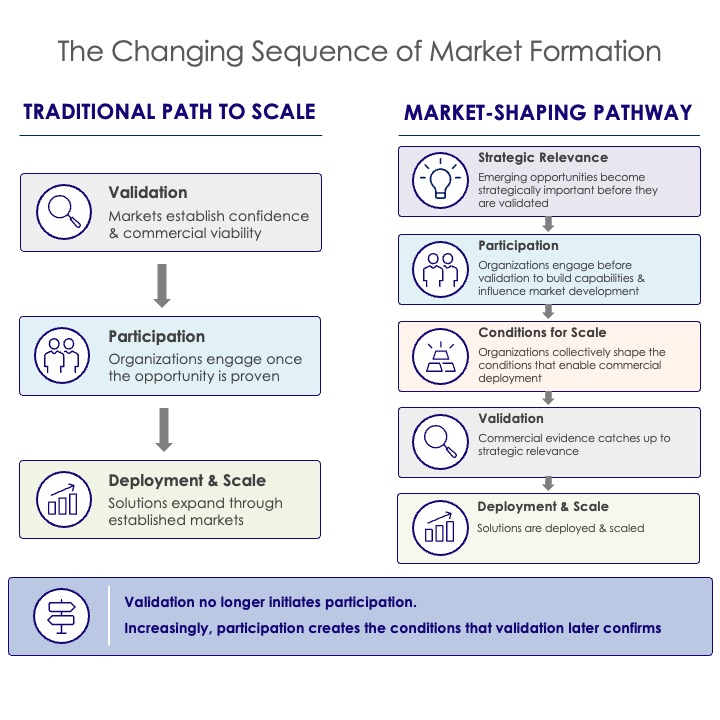
Historically, organizations could afford to wait and see. Technologies emerged, markets matured and business models proved themselves before executives were forced to take action. Validation came first. Strategy followed.
That sequence has reversed, and the pace has increased dramatically.
Technologies now become strategically relevant before commercial pathways are established. Instead of waiting for markets to develop, organizations must decide whether to invest, partner, pilot, advocate, adopt or change course — fateful choices that will shape their access to customers, capital, talent, policy influence and future market opportunities.
The result is a fundamental shift in how organizations make strategic decisions. Rather than responding to existing markets, they are increasingly reacting to emerging possibilities. The question is no longer simply whether a technology will succeed, but whether waiting for proof creates more risk than acting before it arrives.
Markets do not wait for certainty. While organizations seek proof, partnerships are formed, standards emerge, capital is deployed and adoption pathways begin to take shape. By the time a business case becomes obvious, many decisions shaping that opportunity will have been made. The organizations that engage early are not simply responding to emerging markets; they are helping shape them.
Before markets take shape
This dynamic is not new for sustainability practitioners.
For decades, they have engaged with emerging solutions before markets could provide clear signals. Renewable energy, electric vehicles, sustainable aviation fuel and carbon removal all attracted corporate participation well before their pathways to scale were clear. Many sustainability leaders did not simply wait for these markets to mature. Through their collective actions, they helped shape the conditions that made scale possible. In reality, organizations often shape emerging markets even as they try to understand them.
In this rapidly shifting environment, validation has become a lagging indicator of strategic relevance. That lesson is becoming more important as the gap between technological emergence and strategic relevance continues to shrink, and markets increasingly deliver validation only after consequential positioning decisions have been made.
For sustainability practitioners, this changes the role validation plays in decision-making. The challenge has evolved from identifying proven solutions and scaling them to recognizing the strategic relevance of those solutions before definitive market validation arrives.
Position before proof
That means that organizations need a different way to engage with emerging opportunities.
Positioning before proof does not require organizations to commit blindly to uncertain outcomes. It requires them to participate early enough to learn, build capabilities and preserve influence while markets are still taking shape. For sustainability practitioners, that means becoming involved early enough to understand nascent solutions, explore their potential and determine whether they deserve deeper engagement.
Organizations that engage early gain more than information. They influence the conditions that ultimately determine how markets develop. In a world where relevance increasingly arrives before validation, positioning before proof is becoming one of the most important ways organizations prepare for the future while helping shape it.
The conditions you’re waiting for
As organizations engage with emerging technologies earlier, their decisions increasingly become part of the environment that shapes new solutions. The optimal conditions for commercial deployment and market scale are not simply discovered. They emerge through the collective actions of the organizations participating in their development.
This does not mean every organization should move first or place outsized bets. It does suggest that waiting for validation may no longer be a neutral position. In a world where relevance increasingly arrives before proof, organizations are not simply deciding which future to prepare for. They’re also helping determine which futures become possible.
Perhaps the more important question is whether the conditions you’re waiting for are conditions you’re already helping create.

Subscribe to Trellis Briefing

Kelly Cooper